At RED NOSES, we are committed to advancing the scientific understanding of healthcare clowning. A growing number of peer-reviewed studies have examined the impact of RED NOSES clowns, exploring how our interventions affect the well-being of our audiences.
Together with universities, research institutes, and independent academics, RED NOSES has participated in studies across a range of settings, populations, and intervention types. This research strengthens the evidence base for RED NOSES’ work as a legitimate and impactful psychosocial intervention.
Emergency Smile Research Project
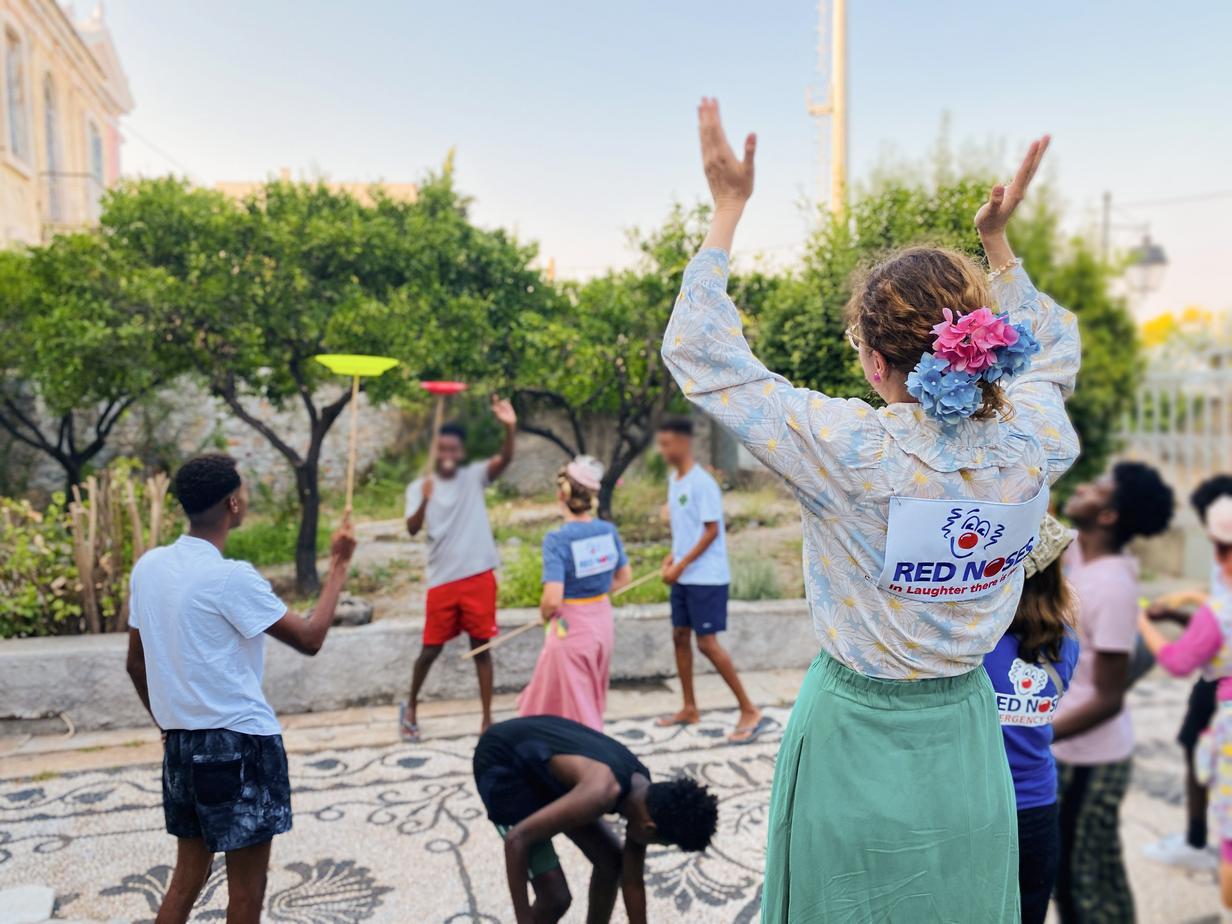
The Emergency Smile Research Project is a pioneering study exploring the emotional and psychosocial impact of healthcare clowning in humanitarian settings.
Taking place in Lesvos, Greece, from 2025 to 2027, the project is conducted in collaboration with the Jameel Arts & Health Lab and WHO Europe, and co-funded by Fondation Alta Mane.
Our publications
De Kock, L., Groot, B., Lindenberg, J., Langemeijer, C., De Faveri, S., Lessiak, K., Fajt, E., Valero, C., & Abma, T. A. (2026). Improving collaboration between staff, family members, and artists in long-term dementia care: A participatory action research project into health care clowning. Qualitative Health Research, 36(1), 60–73
Abstract: A growing amount of evidence shows the positive impact of arts-based interventions in dementia care. Existing studies focus on the impact of such interventions on individuals with dementia, yet there is little known about contextual factors influencing the impact of such practices. Contextual factors include personal and relational processes, such as the collaboration between staff, family members, and artists. It also includes making specific organizational choices about the way in which arts and care organizations structure and organize their collaboration. The study aimed to investigate contextual factors influencing the potential impact of health care clowning for persons with dementia. Through multi-country participatory action research (PAR) into health care clowning in dementia care, this study engaged artists (health care clowns), staff, family members, and representatives from four long-term dementia care facilities and three health care clowning organizations. The presented findings show that for arts-based interventions to have sustainable impact within the context of long-term dementia care, focusing on the intervention itself is not enough. Additional time and space are needed for implementation of the intervention and good collaboration on the work floor. The results of this study demonstrate that elements in the PAR process such as open dialogue and arts-based research methods can create communicative spaces which can serve as a catalyst for effective implementation of arts-based practices in long-term dementia care. Elements of the PAR process can therefore be regarded as a form of successful boundary work and in the future could be applied when implementing arts-based interventions in care settings.
You can access the full publication here
Gräser, M., Grimm, C., & Hoffmann, R. (2026). Humor for health: A randomized controlled trial of clown visits in Palestinian hospitals. World Development, 200
Abstract: Hospitalization can be a highly stressful experience for children, potentially affecting their well-being and recovery. This study evaluates the impact of hospital clown visits on pediatric patients in Palestine. The health system of the country is severely challenged by the ongoing conflict and sociopolitical tensions which have major implications for the physical and mental health of children and obstruct patients’ access to healthcare services. We conducted a randomized controlled trial (RCT) to estimate the effects of clown visits on caregiver-rated health outcomes: children’s well-being during hospitalization, subjective recovery, and perceptions of hospital quality. We find that clown visits had a statistically significant positive effect on children’s well-being with levels of well-being in the treatment group being 0.25 standard deviations higher than in the control group. The effect was stronger among children from higher socio-economic backgrounds and those with a favorable predisposition towards clowns. We found no significant effects on caregiver-rated subjective recovery or perceptions of hospital quality. Our findings suggest that low-cost, non-medical interventions can play a meaningful role in improving the hospital experience for children, particularly in fragile and conflict-affected settings.
You can access the full publication here
Kuduzović, J., Roessler, M., De Faveri, S., & Hebesberger, D. V. (2026). Healthcare clowning in a paediatric allergology department: Perspectives of children, their parents, medical staff, and clown artists. Arts & Health, 1–15
Abstract:
Background: Invasive medical procedures can be distressing for child patients and their parents. This distress can reduce the cooperation with medical staff, making the treatments more difficult. This study examines how healthcare clowning affected children, their parents, and medical staff during procedures in paediatric allergology, and includes the perspectives of the clown artists on their work in this setting.
Methods: Ethnographic observations included 130 children (5–17 years old), 46 parents, 12 medical staff, and five clown artists. Semi-structured interviews were conducted with children, parents, and medical staff, while a focus group discussion was held with the clown artists. Data were analysed through qualitative content analysis.
Results: Healthcare clowning reduced anxiety and diverted attention from procedures among younger children, whereas older children engaged less with the clowns. Parents reported feeling calmer and experienced greater mutual support. Staff described smoother workflow and improved ability to focus on clinical tasks. Effective delivery relied on co-creation between artists and medical staff.
Conclusion: In paediatric allergology, healthcare clowning provides psychosocial support, particularly for younger children and parents, and can support the work of medical staff when integrated into clinical routines. Reduced engagement among older children underlines the importance of developing context- and age-sensitive models of clowning to maximise its benefits.
You can access the full publication here
Friedrich et al. (2025). Short-term effects of clown visits in child and adolescent psychiatric care
Friedrich, A. S. E., Holzmeier, L., Ehlers, J., Seebacher, S., Rössler, M., Skoluda, N., Nater, U. M., & Zemp, M. (2025). Short-term effects of clown visits in child and adolescent psychiatric care: A pilot study on patient stress and mood outcomes and staff evaluations. Frontiers in Psychiatry, 16.
Abstract:
Background: Clown visits are an effective intervention to alleviate patients’ stress and anxiety in pediatric hospital settings. However, while children and adolescents in inpatient psychiatric treatment might uniquely benefit from healthcare clowning, little research has addressed the effectiveness of clown visits in this setting.
Method: This pilot study examined the short-term effects of clown visits on psychological (self-reported stress and mood) and physiological (salivary cortisol) outcomes in 29 children and adolescents aged between 7 and 17 years (M = 12.69, SD = 2.90) in a noncontrolled repeated pre-post design over 4 weeks. In addition, 21 care staff members reported separately on their perceived impact of clown visits.
Results: Self-reported stress levels of children and adolescents were decreased significantly from before to after clown visits, whereas salivary cortisol indicated a similar, but nonsignificant decrease. According to the Multidimensional Mood Questionnaire (MDMQ), patients showed significant improvements in energetic arousal, but there were no effects on mood valence and calmness. The effectiveness of the clown visits did not change over repeated visits. Care staff reported that clown visits had a positive impact on patients’ and their own well-being, but their evaluations regarding their stress levels and work processes on the ward were mixed.
Discussion: The present results provide preliminary evidence that the stress-reducing and energizing effects of clown visits, which previous studies have demonstrated in various pediatric settings, can also be transferred to the field of inpatient child and adolescent psychiatry. Mixed self- and work-related evaluations from care staff suggest that improvements in the implementation of clown visits could help eliminate disruptive elements of this intervention.
You can access the full publication here
Zemp, M., Friedrich, A. S., Holzmeier, L., Seebacher, S., Rössler, M., & Nater, U. M. (2022). Effects of clown visits on stress and mood in children and adolescents in psychiatric care: Protocol for a pilot study. PLoS ONE, 17(2)
Abstract: Scientific evidence has shown that healthcare clowning can decrease the level of stress and anxiety in pediatric patients. However, little attention has been devoted to the potentially beneficial impact of clown visits in the child and adolescent psychiatry setting. Therefore, this pilot study aims at investigating short-term effects of clown visits by RED NOSES Austria on stress and mood levels of children and adolescents in psychiatric care. The sample will consist of approximately 50 children and adolescents in inpatient psychiatric wards who receive clown visits on a weekly basis over four consecutive weeks. The examined intervention, i.e., the clown visits, is an integral part within the selected psychiatric institutions. Using a non-controlled pre-/post-test design, the level of salivary cortisol and self-reported stress and mood will be measured as primary outcomes before and immediately after each clown visit. Additionally, self-reported effects on care staff at the health care facilities will be assessed based on a questionnaire after each clown visit within the same time period of four weeks. Secondary outcome measures (i.e., health-related quality of life, emotional and conduct problems, perceived chronic stress) will be assessed at baseline and at close-out assessment after the four intervention weeks. Further control variables and potential moderators are included at baseline. Due to the nested data structure, multilevel modeling will be used to analyze the data. To our knowledge, this is the first study to examine the stress-reducing and mood-improving effects of clown visits on inpatients in child and adolescent psychiatry. Results will be relevant for the design of future large-scale RCTs and might provide valuable implications for the use of healthcare clowning to reduce stress and improve mood in children and adolescents in psychiatric care. The study is registered at ClinicalTrials.gov (Identifier: NCT04844398).
You can access the full publication here
De Faveri, S., & Roessler, M. (2021). Clowning during COVID-19 – A survey of European healthcare clowning organisations highlights the role of humour and art in the healthcare system. Public Health, 196, 82–84.
Abstract:
Objectives: This paper presents the findings of a Europe-wide survey that investigates the impact of COVID-19 on Healthcare Clowning Organisations and encourages the healthcare community to reflect on the role of medical clowning within the healthcare system.
Study design: Online survey.
Methods: The survey was conducted in June 2020. Forty organisations from 21 countries across Europe responded through a mix of closed and open-ended answers.
Results: During the pandemic, 36 out of 39 of the surveyed organisations (with one non-response) had to postpone or cancel their artistic activities. As the crisis continued, 34 out of 40 of them managed to adapt their in-person activities, but the impact of virtual and distanced interactions with the beneficiaries was generally perceived as lower than that of in-person activities. In open responses, many Healthcare Clowning Organisations criticised the exclusion of medical clowns from healthcare institutions in times when the need for psychosocial support was particularly acute.
Conclusions: The healthcare sector should reconsider the important role the medical clowns play within healthcare settings, and allow for more inclusive and flexible safety regulations that take into consideration the holistic well-being of vulnerable groups, especially children, the elderly, and medical staff.
You can access the full publication here
Markova, G., Houdek, L., & Kocabova, Z. (2021). To the operating room! Positive effects of a healthcare clown intervention on children undergoing surgery. Frontiers in Public Health, 9.
Abstract: In the present study we examined the positive effects of a healthcare clown intervention on children undergoing surgeries, and the role parent-child relationships may play in their effectiveness. Children between 5 and 12 years, who were scheduled to undergo elective surgical procedures in a large university hospital, were randomly assigned to an intervention group (IG; n = 35) that was visited by a healthcare clown, and a control group (CG; n = 27) that received treatment as usual (i.e., company of parents before the surgery). Children in both groups were videotaped and the videos were later used to rate their activity, arousal, emotional expressivity, and vocalizations. Additionally, children and parents rated their mood and perceived quality of life at several points during the procedure, and parents reported their perceptions of the relationship with their children. Results showed that children in the IG showed more positive emotions and vocalizations than children in the CG. Parents of children in the IG also reported more positive mood than parents of children in the CG. In contrast, children in the CG reported higher quality of life than children in the IG. Importantly, analyses showed considerable effects of the parent-child relationship on all outcome measures. Results of the present study demonstrate that a healthcare clown intervention had some positive effects on behaviors and mood of hospitalized children and their parents. Importantly, our findings also suggest that we need to consider the pre-existing “relationship microcosmos” that the clowns enter when assessing their effectiveness in the hospital.
You can access the full publication here