
Innovation Fund Spotlight: EmpowerTeens
Young people in psychiatric wards are often in the most vulnerable moments of their lives. EmpowerTeens, developed by RED NOSES Poland, wanted to explore how the creativity and humour of healthcare clowns could offer them something meaningful. Working in psychiatric wards for adolescents in Warsaw, Sosnowiec and Poznań, the project sought to create an entirely new format for this kind of work. When Anna Olejnik, artistic project lead, is asked to squeeze her impression of the project into just three words, she cannot quite manage and reflects, ‘freedom, care, courage —or perhaps play, love, heal’. Still, these words are not nearly enough to capture what happened between August 2023 and June 2025.
A project that started by asking questions
Many projects start with the answers already prepared and solutions already defined. EmpowerTeens, however, started off with questions. Before a single workshop was held, the team spent months researching the realities of adolescent psychiatric care in Poland, consulting with medical staff, psychotherapists, specialists (e.g. in the fields of suicidology and prevention) as well as with experts in youth theatre. A particularly important collaboration was formed with Jitka Rosenova from RED NOSES Czech Republic, who had already developed a well-established approach to psychiatric clown work there. In her function of artistic lead, Anna travelled to Prague to observe their work first-hand, after which Jitka came to Warsaw to lead an intensive two-day workshop for the Polish team. EmpowerTeens would not have had the depth and expertise it had without this important foundation.
 Enlarge photo
Giving young people a space to ‘be’
Young people today face a paradox: radical loneliness and a total absence of privacy, both at once. Social media places adolescents permanently online, being visible, compared and judged. Beauty, lifestyle, fitness, success, relationships – everything is displayed and commented upon. The boundary between school and home has dissolved, and the pressure to overachieve, from peers and parents alike, leaves almost no room to breathe. As Anna puts it: ‘There is no space for adolescents to know who they are, make friends and acquire resilience.‘
Many adolescents also feel deeply alone, unable to show their real face to others, uncertain how to be with themselves, and increasingly drawn toward virtual worlds as an escape from a reality that feels neither safe nor welcoming. ‘That is why safety, freedom and space for play are so crucial to their healing, for making connections and recovering agency and self-esteem,‘ Anna stresses. What these young people needed was not more structured tasks or performance expectations. What they needed was a space for play, imagination and simply being present.
A format built on safety and trust
Three possible formats were developed and two were tested in practice: regular weekly workshops and an intensive five-day series. It became clear that building trust and a sense of safety with young people in crisis takes time, and that a single session would never be sufficient to create the conditions for real openness. Weekly workshops proved to be the most effective approach.
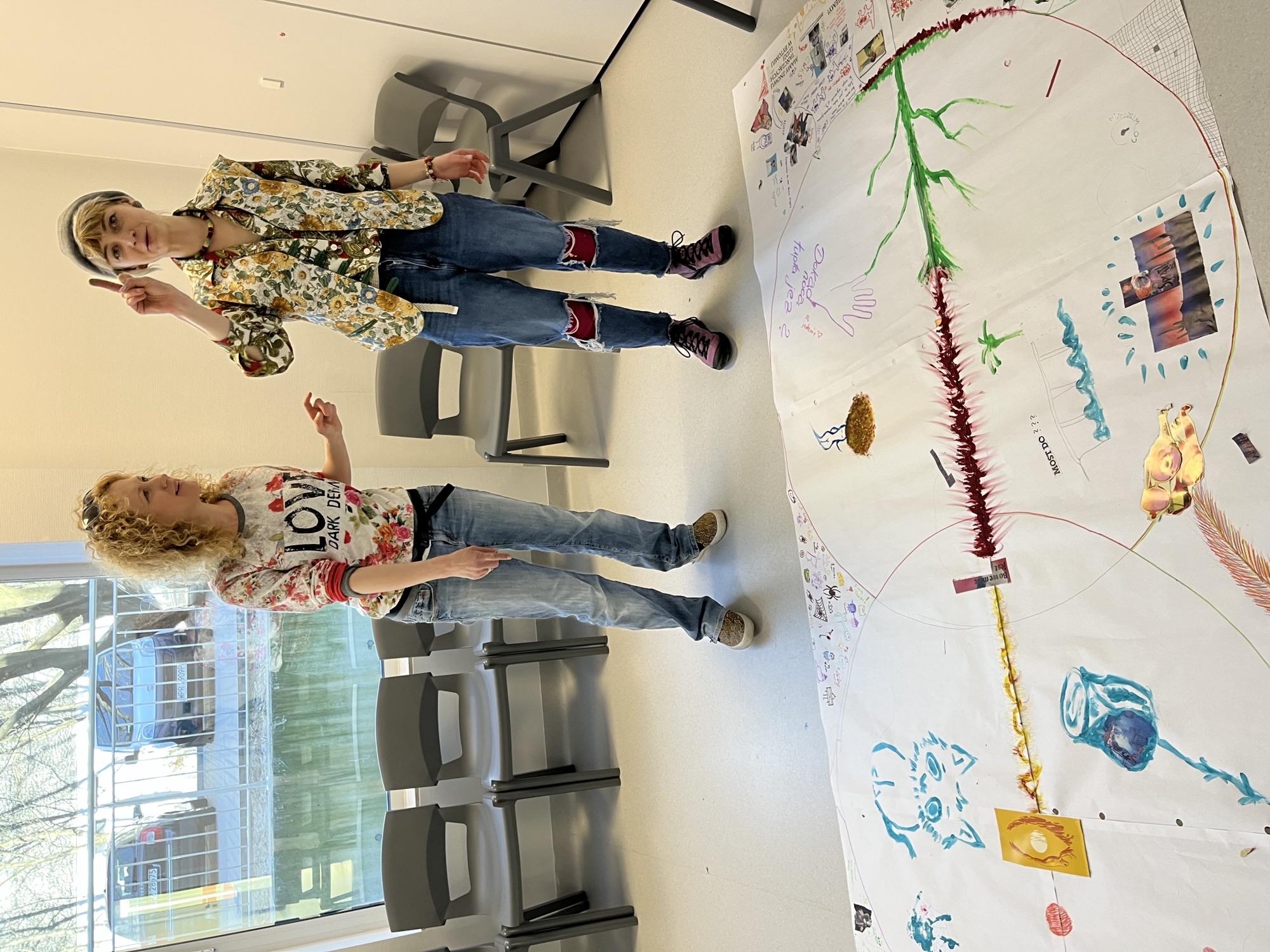
From this process, ten core principles emerged, among them free will, acceptance, playfulness, expression and improvisation. Sessions were kept to around 90 minutes, after the team observed that longer workshops generated too much emotional pressure for many participants to manage comfortably. Each session followed a gentle, consistent structure: a welcome circle, a round of light-hearted questions to encourage safe self-expression, a warm-up, a creative main activity, and a calm, reflective close. Activities ranged from making music with unusual instruments and creating stories together, to circus skills and clown relaxation. If a young person showed reluctance to take part, the clowns would follow their lead, adjust, or offer alternatives. Participation was never required — a young person could sit quietly, read or simply be present.
 Enlarge photo
Meeting young people where they are
The adolescents the team worked with were often navigating very difficult moments in their lives. For the clowns, this meant developing a range of personal and professional competences alongside their artistic skills: the capacity to manage their own emotional responses, to remain fully present without becoming over-involved and to stay genuinely attentive without stepping beyond their role.
In the process, the artists themselves were changed. They developed far greater patience – the capacity to simply be with teenagers without filling the silence or pushing toward outcomes. They grew in their respect for the realities these young people were living in, and in their openness to joy in whatever form it arrived. ‘Their world is all about relationships and connections,‘ Anna notes.
The importance of connection was also shown in an anonymous survey asking participants what they enjoyed most. It revealed that many responses simply said: ‘I love Mrs. Claudia’ — one of the clown artists who spent the most time with them. Alongside this, the team also understood that high artistic quality mattered just as deeply. Adolescents are perceptive and critical, and the clowns owed it both to them and to their own integrity to offer something genuinely valuable.
Small moments carried great significance. One boy, around eleven years old, had refused every activity at the start because he was convinced that he would fail at anything he tried. By the end of the series, something had shifted. He was much more self-confident and said simply that ‘it was nice to be able to try new things in safe conditions.’ Staff also reported that following project sessions, young people were calmer, more open to contact, and more willing to engage with their therapists. These are meaningful changes for the overall healing processes of the young patients.
Building knowledge and looking ahead
For the work to continue and grow, certain foundations are important, even essential. Sustaining the artistic team of EmpowerTeens requires care: ongoing supervision, space for reflection and creative development, and the budget to keep a steady group of artists together. The continuous aspect matters enormously. The emotional demands are sometimes heavy, too: the suffering the team encounters is often extreme and the ability to process these experiences together in live meetings (rather than over a screen) is what keeps the team intact.
The format developed through EmpowerTeens is considered transferable to other countries and contexts, with appropriate adaptation to local needs and systems. What matters most is not the specific activities, but the values that form their basis: listening before acting, responding to the real needs of young people, and understanding that meaningful change in mental health work is relational, gradual, and cannot be rushed.
Facts and Figures
- 340 children and adolescents reached across four psychiatric wards
- 60 hospital visits conducted
- 40 healthcare staff engaged (therapists, nurses)
- 17 clowns involved in delivering the project
- 5 psychiatric wards across three cities visited (Warsaw, Sosnowiec, Poznań)
About the Innovation Fund
The RED NOSES International Innovation Fund is a laboratory for exploring shared creative forces within the RED NOSES group. Since 2021, it has invited RED NOSES artists to develop and share innovative artistic projects. The most promising initiatives are selected by a council and receive grant support, with emphasis on transferability to other RED NOSES countries — ensuring that the entire RED NOSES community can benefit from the learning.
 Enlarge photo