Innovation Fund Spotlight: Blue Heart Circus
Circus activities can offer a way for children to learn about themselves and others, through creativity and play. Blue Heart Circus, developed by RED NOSES Jordan, is a beautiful example of how transformative this experience can be. Through carefully designed circus-inspired activities, this project invited children with Autism Spectrum Disorder (ASD) and their neurotypical peers to explore self-expression, build social skills and gain self-confidence. They connected with the wider community and had the chance to engage with one another in spaces that felt safe and supportive.
Blue Heart Circus was designed around four main components: circus workshops for children with ASD and their peers, ASD toolkit training sessions for parents, Humour Relief sessions for caregivers and families, and advocacy activities, alongside a final circus performance with community leaders. The project was created to be truly comprehensive, promoting a broader culture of inclusion.
 Enlarge photo
 Enlarge photo
 Enlarge photo
Supporting inclusion through circus arts
After recognising the need for inclusive formats supporting children with ASD, the team of RED NOSES Jordan initiated Blue Heart Circus in collaboration with Safe Hands for Training and Rehabilitation, part of the Amena Foundation. One of the aims was to promote social inclusion and enhance the wellbeing of children with ASD from the ages of 7 to 14.
Based on previous experiences where circus methodology had been successful, Artistic Director Lna Dahdal was encouraged to take the next step. ‘By building on that foundation and making intentional adaptations, we were able to design a more inclusive approach that better supported and engaged children with autism through play, movement and creativity’, she explains. Taking place between March and October 2024, the project was brought to communities in Madaba, Balqa and Aqaba.
Lna Dahdal, who is also the artistic lead of the project, tries to capture the project's spirit in three words: connection, playfulness and inclusion. She emphasises the holistic approach of Blue Heart Circus, since it involved the wider community and, while keeping clowning as a core element, extended across all four components: the circus workshops, the ASD toolkit training, the Humour Relief sessions, and the advocacy work culminating in a final community performance. The partnership with Safe Hands for Training and Rehabilitation was essential throughout the project, as the organisation provided important expertise for selecting participants and ensuring that the format was adapted to each child's individual needs.
Preparing artists for inclusive work
Learning about and accommodating those individual needs was a core element of their training, in which healthcare clowns learned to follow each participant's pace. The artistic preparation focused on redesigning parts of the original Circus Smile format to work better in an inclusive setting. Workshops for the artists were practical and focused on real situations they might encounter during the project. They learned how to invite children with different abilities into the magic of the circus, how to create fun and energising games that everyone could join, and how to teach the children new skills.
Lna Dahdal remembers that the training did not only convey certain techniques but especially helped her to deepen her understanding of presence and listening beyond verbal communication: 'As an artist, I learned that simplicity, authenticity, and sensitivity are far more powerful than performance'. A big part of the process was also learning to stay flexible, reading the children's moods and energy levels and adjusting activities on the spot.
 Enlarge photo
 Enlarge photo
Adapting the format to support inclusive participation
The format was carefully adjusted so that each element could be accessed by children with a wide range of needs. Daily rituals played an important role in creating structure and familiarity. These included greeting activities with music and physical gestures such as high-fives, imaginative transitions into the ‘circus space’, and consistent use of repetition, including names, movements, and sounds. These routines helped children feel secure and prepared for each session.
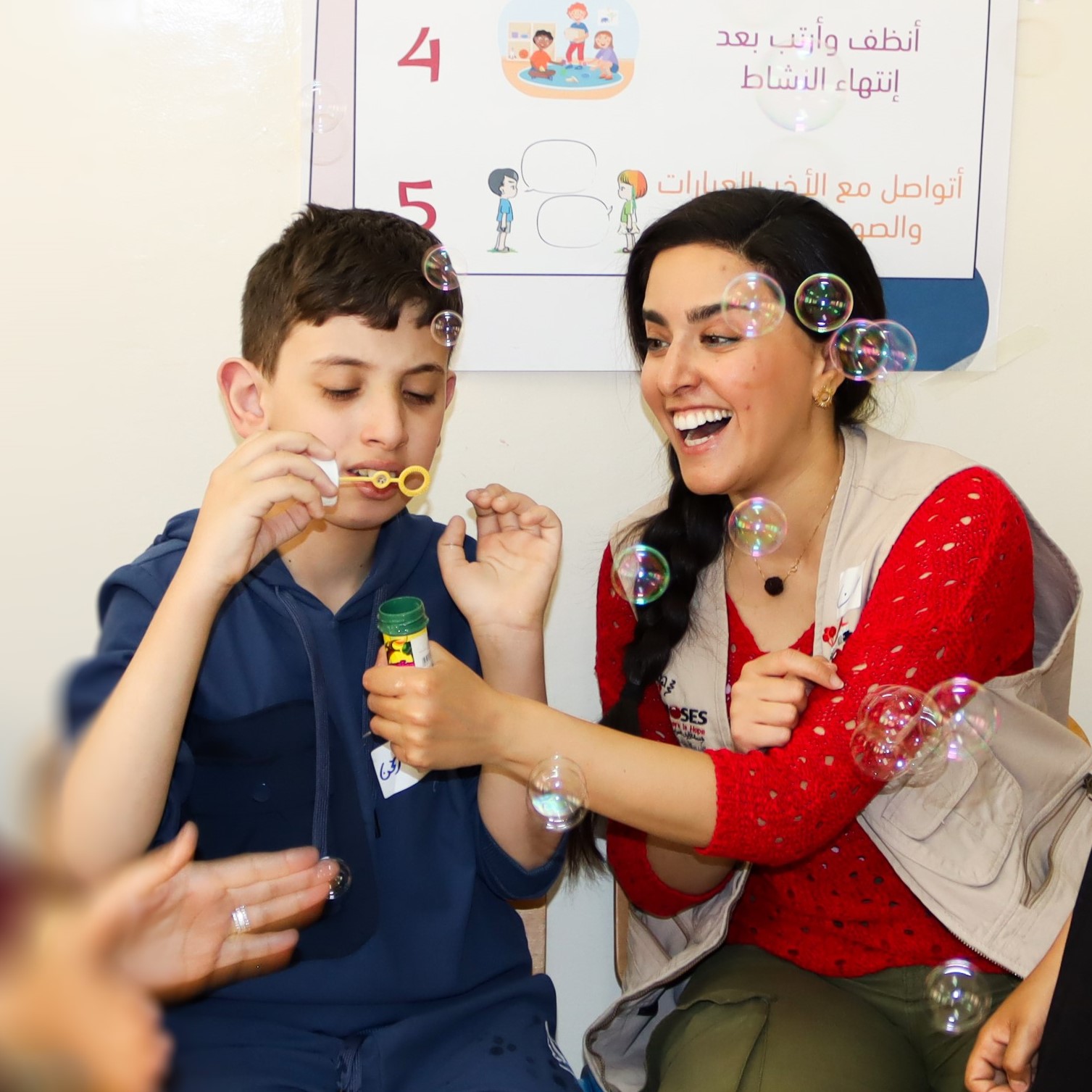
Simple props such as scarves, ribbons, hula hoops, and bubbles provided sensory-friendly ways to engage with activities and clowns learned to turn circus techniques into inclusive games that encouraged participation without pressure. One parent shared, ‘My son has become more confident and interacts more with his peers. The circus activities have made a big difference’.
Including the wider community and working toward common goals
Blue Heart Circus was committed to genuine inclusion. Rather than running separate sessions, children with ASD participated alongside neurotypical peers, as children from local schools, neighbourhoods, and family networks were invited to join the activities. This helped create shared experiences rather than separate activities and supported natural interaction between participants.
Close cooperation with local centres and families ensured consistent support and helped each child feel welcomed and respected throughout the project. Participants worked together on shared tasks, such as creating a group circus curtain for the final presentation. These activities were built on cooperation and interaction in a way that allowed children to relate to one another and experience working toward a shared goal, seeing one another not as different, but as co-creators. The final performance was also a moment of advocacy, highlighting the need for more inclusive spaces and demonstrating the inspiring and motivating effects if such spaces exist.
Making a difference for children, parents and the community
The project was accompanied by an evaluation report which showed encouraging results. Blue Heart Circus had a real impact on children with ASD, their families, carers, and the wider community. Every single child who took part improved their social skills, becoming more confident and more at ease in group settings, while 80% grew stronger in motor skills through activities like juggling and balancing.
But behind every number is a person. As Lna Dahdal shares, ‘What was especially memorable were the small breakthroughs: a child maintaining eye contact, initiating play, or repeating an action with joy. These moments, although subtle, carried deep meaning and showed how play can create trust and communication beyond words’.
The effects of the project extended beyond the children themselves. Through the ASD toolkit training sessions, parents learned practical strategies which they could use in their everyday lives of raising a child with ASD. The Humour Relief workshops offered caregivers and families a space to build resilience and find joy amid the challenges they face. Nine out of ten parents noticed better interactions with their children, and 85% felt more able to cope with stress. One mother confirms, ‘The Humour Relief workshops were incredibly helpful. I feel more equipped to handle stressful situations at home’. A father described how the training changed the way he and his daughter communicate day to day.
For the professionals involved, including social workers, educators and therapists, the project also brought something valuable. Three-quarters learned about new ways of supporting children through difficult moments, and 80% felt better in managing their own stress after the Humour Relief workshops.
 Enlarge photo
Looking ahead to needs and the potential of Blue Heart Circus
Blue Heart Circus has shown what can be achieved when creativity, community and commitment come together. Its four-component structure, namely reaching children, parents, caregivers and the wider community, offers a model worth building on. Looking to the future, Lna Dahdal emphasises that sustainable funding and partnerships with schools, therapy centres, and organisations working with children with ASD are essential to increase the impact. Continuous training for artists in specialised approaches would ensure that quality and sensitivity are maintained. Broader advocacy matters, too. She explains, ‘community awareness and support are essential to create more inclusive spaces where such formats are valued and integrated’.
Facts and Figures
- 42 participants in toolkit training sessions
- 48 children with ASD and neurotypical peers participated
- 90 family members engaged throughout the project in Humour Relief Sessions
- 215 community leaders reached through advocacy and awareness activities
About the Innovation Fund
The RED NOSES International Innovation Fund is a laboratory for exploring shared creative forces within the RED NOSES group. Since 2021, it has invited RED NOSES artists to develop and share innovative artistic projects. The most promising initiatives are selected by a council and receive grant support, with emphasis on transferability to other RED NOSES countries — ensuring that the entire RED NOSES community can benefit from the learning.