
Growing together: Artistic education - 2025 in review
2025 marked a change in our approach to organising the workshops in Vienna. Having built a closer relationship with our teachers, being in constant exchange with them, our Artistic Directors and our artists, the planning was strongly influenced by collaboration rather than doing, focus topics were developed.
Within these focusses, workshops were clustered with the aim to establish a common understanding of the contents. Through this, the thematic approach became better visible. The topics were on one hand focussing on our programmes, on the other hand they were focussing on basics that are always good to remember, to refresh, to work on.
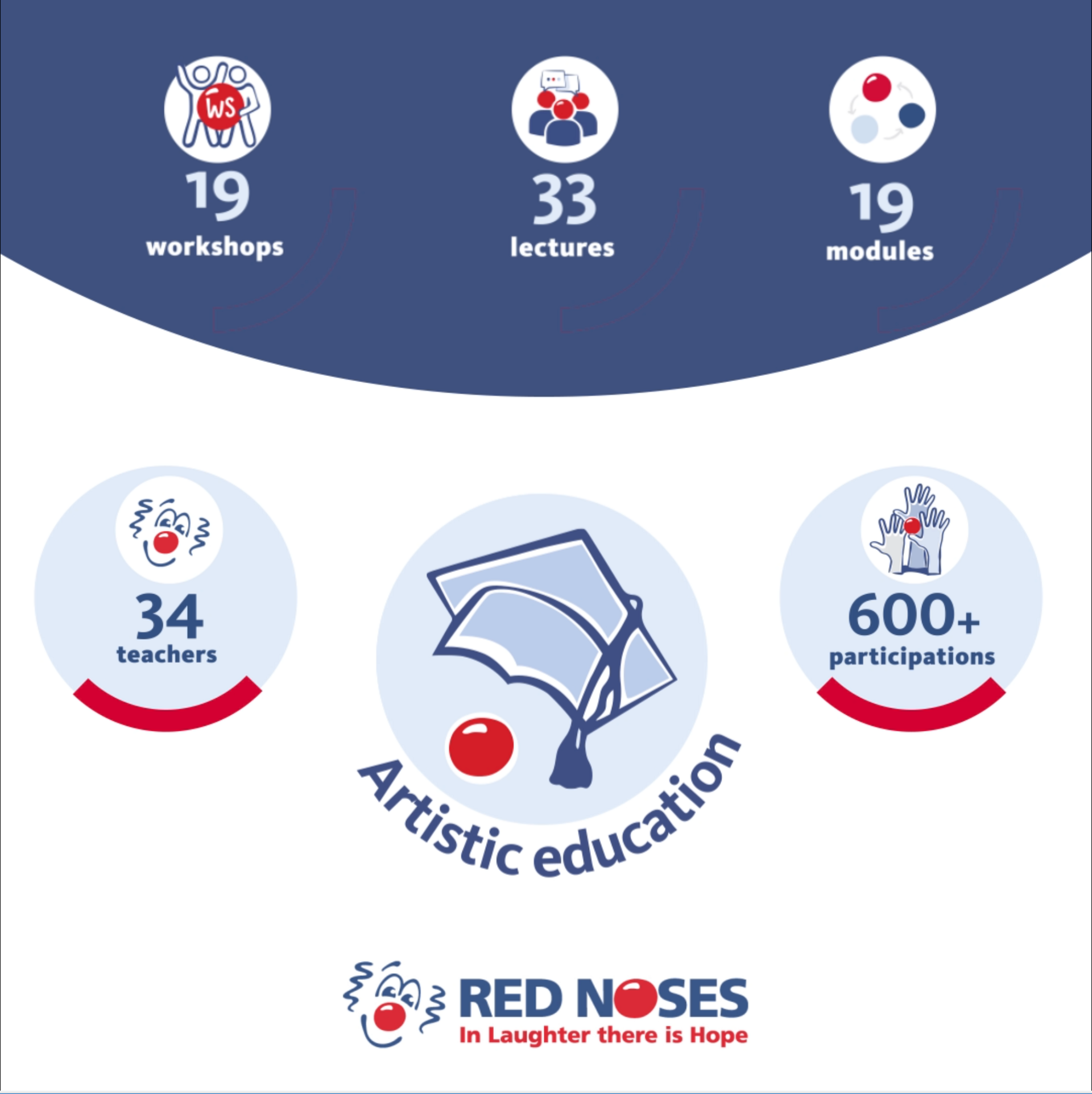
In total, 19 workshops, 33 lectures held by 34 teachers with more than 600 participations took place in Vienna and online. These workshops were clustered into five focus topics, creating a clear structure and shared understanding across the education programme.
 Enlarge photo
Lory Leshin workshop - Complicity and conflict in the clown duo. Having fun while playing status.
10 years of the RED NOSES International Curriculum
In 2025, the RED NOSES International Curriculum celebrated its 10th anniversary. Over the past decade, the curriculum has supported a more intentional education of our artists, expanding their knowledge not only on a practical artistic level but also on theoretical topics that deepen their understanding of their work.
After 10 years, with more than 400 artists actively working for us, we are facing new challenges. The number of artists graduating from our basic education is growing, while the number of artists starting fresh is becoming comparably small. This shift increases the need for further education – artistically, but also in deepening and broadening theoretical knowledge.
The five focus topics of ISH 2025
1. DNA of the clown / humour systems
The first focus topic was “DNA of the clown / humour systems”, the most basic one. It works on awareness, knowledge of the body, a skill set, a toolbox, the “clown antennas”. These are the topics a clown needs to work on throughout their entire clown life.
This year, the focus lay strongly on physical work. Jos Houben gave workshops on the age of the body and the age of the clown. The age of the body is fully connected to the person behind the clown – its abilities defined by age, with its limitations but also its chances.
Michal Chovanec, from RED NOSES Czech Republic and physical comedy specialist, gave a workshop on the practical implementation of physical comedy in the environments we are working in. Due to defined spaces and possibilities, it might seem hard to use this kind of humour – but he proved the participants wrong and opened their eyes to unlimited possibilities.
Ami Hattab went on a deep dive with our already certified artists, focussing on the duo – how to find new ways to build relationships between the characters and how to use improvisation. Using the technique of the neutral mask, Tina Janežič from RED NOSES Slovenia and Sara Corsini supported their participants in understanding, identifying and magnifying the physical and behavioural parts that define their clown.
Reinhard Horstkotte, Artistic Director of ROTE NASEN Deutschland, invited participants to find resilience in difficult situations. His so-called “Bubble” offers possibilities of play in uncomfortable situations that might occur anytime during a visit, when the presence of a healthcare clown might be seen as disturbing.
We also had the pleasure of inviting our founder Giora Seeliger to give one workshop this year. He worked with duos on the timing, tension, climax and punchlines of a sketch or number, as this defines its success or flop.
 Enlarge photo
Lory Leshin workshop - Complicity and conflict in the clown duo
2. Awareness, diversity, equity & inclusion
The second focus topic was “Awareness / Diversity / Equity / Inclusion” – topics that concern all of us, professionally and privately. Naturally, our clown artists are affected by these themes as well: the human behind the nose as well as the clown himself.
Aitor Basauri and Dashia Magee gave two workshops, working with the artists on stereotypes, racism, sexism, diversity and everyday challenges a clown has to deal with. How can a clown face these topics? Where does more consciousness and awareness need to be applied? These questions and many more were explored and translated directly into clown work.
The combination of Aitor, an internationally acclaimed clown and director, and Dashia, a pedagogue and DEI expert, led to intense workshops dealing with sensitive matters, opening discussions while never forgetting laughter.
Focussing more specifically on clowning for people with disabilities, Hanneke Heessels worked with the artists on tuning their senses. In this field, as well as in clowning for older adults, the senses play a very important role. By trying out approaches and offering tools, artists sharpened their “antennas” and returned with a clearer understanding of how not to overwhelm the people they encounter.


3. Partner work
Out of the nature of our work, partner work is a very strong focus, leading to the third topic: “Partner Work”. A big part of this is dedicated to the duo but also includes all play with other people, including also healthcare staff or audiences.
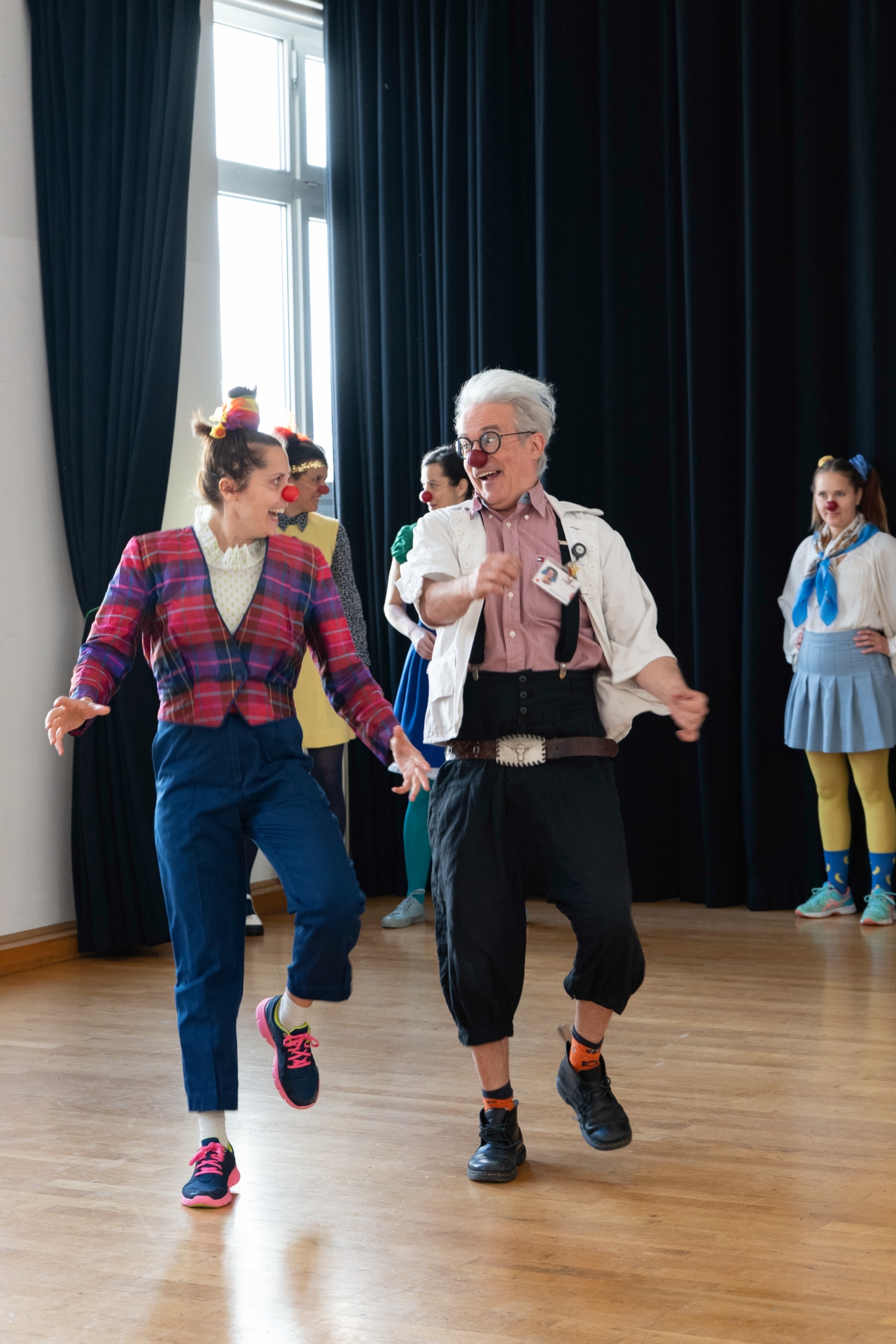
Lory Leshin gave two workshops on complicity and working in duos but with different approaches – one for artists who have been with us for a shorter time, and one for artists with longer experience. In the beginning, curiosity often drives discovery and possibilities. Over time, routines develop, comfort grows and things start running by themselves. This is where Lory’s workshops aimed: disrupting habits, challenging comfort and reigniting curiosity and new impulses.
Working further on the duo, Ami Hattab led a series of two-part workshops dedicated to artists who are working together as a duo in their countries. These workshops allowed participants to deepen their understanding of each other, become more aware of their partner’s needs and explore new possibilities together.
4. Clowning for older adults
As one of our programmes focusses on clowning for older adults, this was the fourth focus topic. Magdalena Schamberger and Andrea Kiss worked in two separate workshops on deepening knowledge of the needs of this age group, as well as the challenges when approaching people suffering from dementia.
Irena Feithová gave a workshop focussing on dance and movement. For older adults, movements need to be bigger and slower in order to be fully perceived. She also worked on instant aging, offering participants the opportunity to experience the challenges of becoming older by using tools such as weights or vision impairments.
 Enlarge photo
Lory Leshin workshop - Working in duos, fun and freedom. Renewing, evolving, breaking out of routines.
5. Clowning in crisis settings
The fifth focus topic of 2025 was “Clowning in Crisis Settings”. Through our Emergency Smile International (ESI) team as well as local teams, we are working with displaced people. Clowning under these circumstances differs from our usual visits.
In these settings, artists often work in groups of three or four clowns, using music and parades. Two workshops were offered especially for ESI team members. One workshop, held by Alé Duarte, focussed on empowering children to self-regulate while dealing with crisis situations.
The second workshop was held by Lory Leshin, this time focussing on the trio rather than the duo. The hierarchy within a trio is different and artists need to feel comfortable within it. Lory worked with the team on exploring both possibilities and challenges. This workshop was also offered to artists working in local crisis settings.
Additionally, Pavel Mihaľák, Artistic Director of RED NOSES Slovakia, offered a workshop on musicality. Trying out instruments, rhythm and voice, creating songs and becoming comfortable using all of these elements was the focus of Paly’s workshop.


Online (theoretical) education
In addition to the artistic workshops in our rehearsal room in Vienna, many theoretical topics of the curriculum were offered online. Twice in 2025 – once in spring and once in winter – artists had the opportunity to participate in online lectures, discussions and international exchange.
Each time, three weeks of lectures were dedicated to this support. Across six weeks, 33 lectures were offered by a total of 12 teachers, covering 13 modules of our education, with over 350 participations. The teachers, both RED NOSES internal and external experts, covered topics such as drivers, structures and programmes of RED NOSES, history and theory of (healthcare) clowning, psychology (with a focus on humour and age), sociology and communication.
We are very grateful for the continuous support of all our teachers – long-standing ones as well as new ones. Their knowledge and expertise help us constantly refine and develop our clowning skills and approaches, and through this, we continue to improve the experience of our audiences.
 Enlarge photo
Lory Leshin workshop - Complicity and conflict in the clown trio, partner work.